In a world where teams are distributed, regulatory pressures are rising, and data grows exponentially, a Cloud Document Management System (Cloud DMS) is no longer a “nice-to-have” it’s a competitive necessity. By centralizing content, automating workflows, and strengthening governance, Cloud Based Document Management Systems help organizations work faster, smarter, and more securely. This article explores the key benefits, the role of metadata and indexing in Cloud DMS, and best practices for Cloud Document Management Security, along with FAQs tailored to common long‑tail queries.
What Is Cloud Document Management?
Cloud Document Management (often called Document Management on Cloud) refers to storing, organizing, securing, and collaborating on documents via a cloud platform rather than on local servers. A modern Cloud Document Management System typically includes version control, access permissions, full‑text search, e‑signatures, workflow automation, retention policies, and integrations with core business tools (email, ERP, CRM, HRIS).
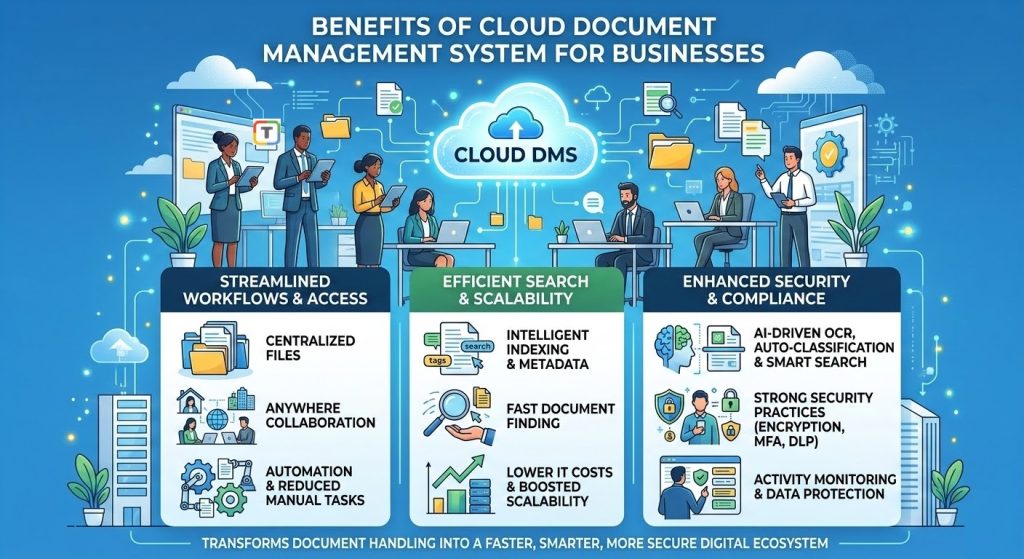
Core Business Benefits
1) Faster, Smarter Workflows
A Cloud Based Document Management System streamlines document-centric processes across departments—procurement approvals, onboarding, contract reviews, audits, and more. Automated routing, reminders, and role-based approvals reduce manual handoffs and bottlenecks. Staff can find the right version instantly, collaborate in real time, and maintain a clear audit trail.
Why it matters: Reduced cycle times, fewer errors, and transparent accountability.
2) Anywhere Access and Real-Time Collaboration
Remote and hybrid teams need secure access to documents wherever they are. With Document Management on Cloud, users can search, edit, comment, and co-author files from any device, minimizing duplication and email chaos. External stakeholders (vendors, clients) can be granted controlled access without creating security risks.
Why it matters: Higher productivity and better stakeholder experiences.
3) Lower Costs and Better Scalability
On-premises systems demand upfront hardware, maintenance, and upgrades. Cloud Document Management shifts costs to an operational model, with elastic storage and performance scaling as your content grows. You only pay for what you use and can roll out features incrementally across teams or regions.
Why it matters: Predictable costs and faster time to value.
4) Stronger Governance and Compliance
Cloud DMS platforms provide granular permissions, activity logs, retention schedules, and legal holds to help you meet industry-specific regulations. Automated policies reduce manual effort and decrease compliance risk.
Why it matters: Reduced exposure in audits and simplified regulatory reporting.
5) Enhanced Security
Cloud Document Management Security goes beyond passwords. Modern platforms offer encryption at rest and in transit, SSO/MFA, DLP (Data Loss Prevention), conditional access, malware and ransomware detection, and anomaly monitoring.
Why it matters: Protects sensitive data while enabling agility.
The Role of Metadata and Indexing in Cloud DMS
A powerful—often underestimated—advantage of Cloud DMS is the Role of Metadata and Indexing in Cloud DMS:
- Metadata (e.g., document type, owner, department, effective date, customer ID) structures unstructured content, enabling precise filtering and policy-based automation.
- Indexing turns files into searchable assets. Full-text indexing plus metadata fields delivers lightning-fast discovery, even across millions of documents.
- Automation hooks use metadata to trigger actions: route to Legal if “Contract Type = NDA,” or apply “Finance retention = 7 years” to invoices.
- Reporting & insights use metadata to surface bottlenecks, SLA breaches, and compliance gaps.
Bottom line: Metadata + indexing transform storage into a dynamic, findable, and policy-driven Cloud Document Management System.
Automation and Workflow Management in Cloud DMS helps teams operate at scale:
- Configurable workflows: Drag‑and‑drop builders for approvals, reviews, and escalations.
- Rule-based triggers: Auto-classify documents; assign tasks based on metadata.
- Notifications & SLAs: Reminders for overdue actions; escalations to managers.
- Audit trails: Every action is logged for compliance and quality control.
This combination eliminates manual rework and ensures consistency, turning your Cloud DMS into a true process engine.
Integration of AI in Cloud Document Management unlocks next-level efficiency:
- Intelligent capture & OCR: AI extracts data (invoice totals, dates, POs) and tags files automatically.
- Auto-classification & suggestions: The system predicts document types and proposes metadata.
- Semantic search: Finds concepts and context, not just exact keywords.
- Data quality & governance: AI flags duplicate or sensitive content and suggests remediation.
- Insights: Analytics surface trends in document flow and risk exposure.
AI reduces manual indexing, improves accuracy, and speeds discovery—especially at enterprise scale.
Cloud Document Management Security Best Practices
To maximize resilience, adopt these Cloud Document Management Security Best Practices:
- Zero Trust access: Enforce least-privilege, SSO, and MFA.
- Encryption everywhere: TLS in transit, strong encryption at rest, and scoped key management.
- Granular permissions & sensitivity labels: Map access to roles and document classifications.
- DLP & eDiscovery: Prevent exfiltration and respond quickly to legal requests.
- Activity monitoring & alerts: Detect anomalies (mass downloads, odd hours, privilege misuse).
- Ransomware defences & immutability: Versioning, file restore, and immutable backups.
- Vendor due diligence: Review certifications (e.g., ISO 27001, SOC 2), data residency, and incident response SLAs.
- Lifecycle policies: Automate retention and defensible disposition to reduce data risk.
- Regular training: Make secure handling and classification part of team routines.
How Cloud Storage is Transforming Document Management
Cloud storage is more than a repository—it’s the foundation for How Cloud Storage is Transforming Document Management:
- Unified content layer: One source of truth across teams and apps.
- APIs & integrations: Connects with CRM/ERP/HR systems and e‑signature tools.
- Real-time collaboration: Co-authoring, comments, and presence awareness.
- Analytics & AI services: Native capabilities enrich documents with intelligence.
- Elastic scale: Handle surges in projects, seasons, or M&A without re-architecting.
This synergy transforms documents from static files into living assets that drive outcomes.
FAQ’s
1) How Cloud-Based DMS Improves Workflow Efficiency?
A Cloud Based Document Management System automates routing, approvals, and reminders while ensuring everyone works on the latest version. Metadata-driven rules reduce manual tasks, and dashboards highlight bottlenecks. Result: faster cycle times, fewer errors, and better accountability.
2) How Cloud Storage is Transforming Document Management?
By centralizing content, enabling real-time collaboration, and integrating AI for search and classification, cloud storage underpins a modern Cloud Document Management System. It converts scattered files into a unified, searchable, and policy-driven knowledge base accessible from anywhere.
3) What Are the Benefits of Cloud Document Management System?
Top benefits include improved productivity, lower total cost of ownership, elastic scalability, stronger governance, robust security, and AI-enabled automation. This combination helps organizations move faster while reducing risk.
4) What Are Cloud Document Management Security Best Practices?
Implement Zero Trust access (SSO/MFA), encryption at rest and in transit, granular permissions, DLP, audit logging, versioning with ransomware recovery, vendor compliance checks, and automated retention policies. Train users regularly to maintain strong security hygiene.
5) What Are Data Security Challenges in Cloud Document Management?
Key challenges include misconfigurations (over-permissive sharing), shadow IT, data residency requirements, insider threats, and sophisticated phishing/ransomware. Mitigation depends on strong identity controls, continuous monitoring, governance policies, and secure vendor selection.
6) How Does Automation and Workflow Management in Cloud DMS Help?
Automation reduces manual effort, standardizes processes, and provides consistent audit trails. Workflows ensure tasks reach the right people, while reminders and SLAs prevent stagnation. You gain speed, consistency, and visibility.
7) What Is the Integration of AI in Cloud Document Management?
AI enhances capture (OCR and data extraction), auto-classifies files, enriches metadata, improves semantic search, and flags anomalies. It elevates accuracy and saves time, especially when dealing with large volumes of unstructured content.
8) What Is the Role of Metadata and Indexing in Cloud DMS?
Metadata and indexing make documents findable and governable. They drive precise search, enable policy-based automation (retention, access, routing), and power analytics. Without them, a DMS is just storage.
Explore Titan Workspace to simplify SharePoint management, improve governance, and automate your digital workspace operations with ease.