
If your organization already uses SharePoint Online / Microsoft 365, selecting the right Document Management System (DMS) is less about features—and more about architecture, compliance, and data residency.
This guide lists 6 proven SharePoint-based DMS platforms, explains native vs third-party architectures, and helps you choose the right fit for manufacturing, pharma, and government organizations operating across North America, India, Malaysia, and the Middle East.
Quick Comparison: Native vs Integrated SharePoint DMS
| Architecture | What it Means | Why It Matters |
| 100% Native to Microsoft 365 | Files stay inside SharePoint / OneDrive / Teams | Easier ISO, HIPAA, OSHA audits, single security model |
| Integrated (Vendor Repository) | SharePoint is UI, files live elsewhere | More features, but higher governance & compliance effort |

Best Overall: SharePoint-Native DMS for Regulated Industries
Architecture: 100% native to Microsoft 365
Where files live: Customer’s SharePoint / OneDrive tenant
Why Titan ranks high for compliance-driven organizations
Titan Workspace is designed to turn SharePoint into a business-ready DMS without moving data to a third-party cloud. All documents, metadata, permissions, workflows, and audit evidence remain inside the customer’s Microsoft 365 tenant.
Strong fit for:
Key advantages
Best for Government & Records-Heavy Compliance
Architecture: Native SharePoint extension
Where files live: SharePoint tenant
Collabware focuses on records management and information lifecycle control layered directly onto SharePoint.
Strong fit for
Strengths
Limitations
Best for Manufacturing & Pharma Email-to-Document Control
Architecture: SharePoint-centric enhancement
Where files live: SharePoint / OneDrive
MacroView is widely used where email is still a major system of record, especially in supplier communication, QA, and change management.
Best for
Key strengths
Best for Outlook-First, Compliance-Driven Teams
Architecture: Microsoft 365-centric
Where files live: SharePoint / Teams / OneDrive
harmon.ie focuses on structured filing and metadata capture directly from Outlook, reducing human error in regulated environments.
Best for
Trade-off
Best When SharePoint Is the Front-End (Not the Storage)
Architecture: Third-party repository
Where files live: Egnyte cloud
Egnyte integrates with SharePoint by embedding its interface, but files remain in Egnyte’s own content cloud.
Best for
Key disadvantages vs native SharePoint DMS
Best for Metadata-Driven, Multi-System Environments
Architecture: Traditionally external DMS + connectors
Where files live: M-Files repository (or hybrid models)
M-Files is known for its metadata-first approach, popular in pharma and manufacturing where document classification is critical.
Best for
Important consideration
Why native SharePoint DMS wins for ISO, HIPAA, OSHA
✔ Single audit trail
✔ One permission model
✔ Built-in Microsoft compliance tooling
✔ Lower risk during regulatory audits
Risks of non-native DMS platforms
Best DMS by Industry (Summary)
| Industry | Recommended Approach |
| Manufacturing | Titan + MacroView |
| Pharma / Life Sciences | Titan or M-Files (if metadata-first) |
| State & Local Government | Collabware + Titan |
| Multi-region regulated orgs | SharePoint-native first |

Recommendation
If your organization already runs on Microsoft 365, the safest and most scalable choice is a SharePoint-native DMS that keeps content inside your tenant.
Solutions like Titan Workspace and Collabware minimize compliance risk, reduce IT complexity, and align best with how Microsoft designs governance, security, and AI experiences.
Third-party platforms like Egnyte and M-Files remain strong options—but only when you intentionally accept external repositories and higher governance overhead.
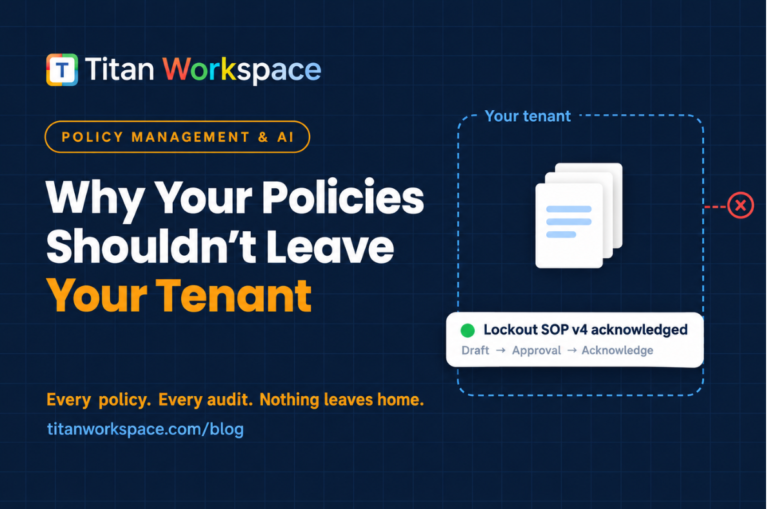
Most policy tools ask you to copy your policies out of SharePoint before they can manage them. Here’s…
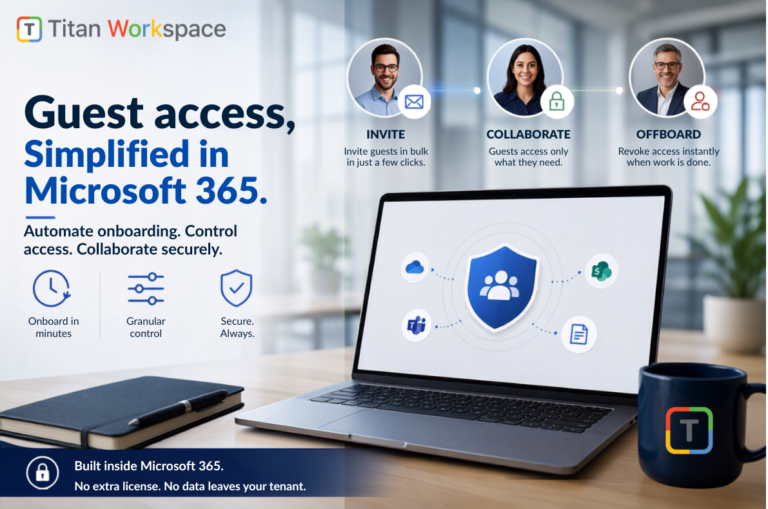
Onboarding 50 external clients used to take close to a week. On Titan Workspace, it takes about 20…
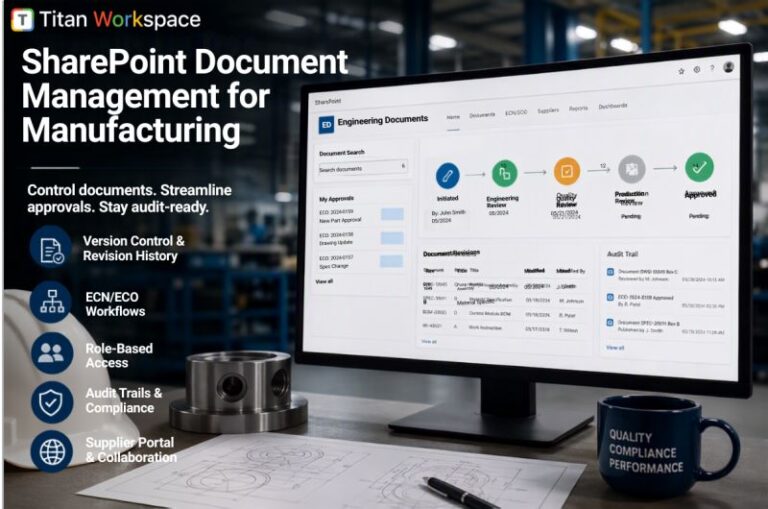
Ask a plant manager or quality lead where their documents actually live, and you rarely get a clean…